
bitcoin lending I
on lava x roam

I was surprised to see that almost nobody is talking about the fact you can now buy a house with a 3% mortgage rate while keeping all your Bitcoin.
I'm not talking about some sketchy offshore scheme with.. interesting founders or a complicated crypto workaround. Crypto being applied to physical, real world applications is something I'm deeply interested in, and this is happening right now in the U.S. housing market, and it's about to change everything ~ all it needs is customers to allow it to rocket.
Two companies have figured out how to connect the dots between trapped low-rate mortgages and Bitcoin liquidity, creating a path that lets you skip the bank, avoid capital gains taxes, and keep your crypto stack intact.
There's $10 trillion worth of mortgages sitting in American homes right now with rates below 4%. Most were written between 2020 and 2022 when the Fed was printing money and rates were basically free.
Now we're in a completely different world. New mortgages are running around 7%, which means nobody wants to move. Sellers don't want to give up their 2.5% rate, and buyers can't afford the new higher payments.
This has created the most frozen housing market in decades.
But here's the thing: some of those old mortgages are actually transferable. They're called assumable loans, mostly FHA and VA mortgages that you can literally take over from the seller instead of getting a new one.
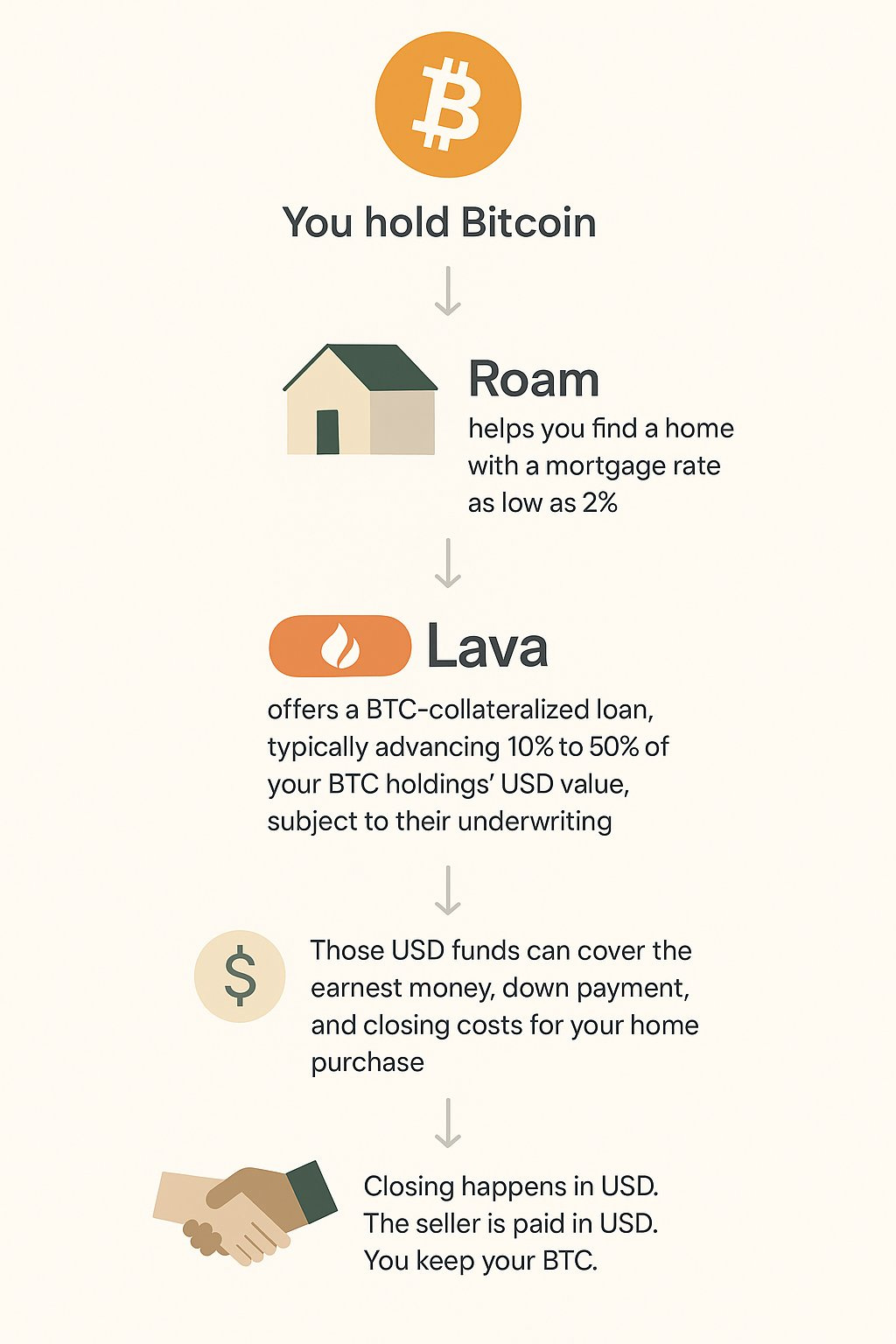
That's where Roam comes in. Roam has built a marketplace specifically for these assumable mortgages. They've figured out how to find homeowners sitting on 2.5% to 3% rates and connect them with buyers who want to take over those loans.
The process is surprisingly straightforward. Instead of applying for a new mortgage at today's rates, you essentially step into the seller's shoes and continue making payments on their old, cheap loan.
Here's a typical scenario. House price: $500,000. Assumable mortgage balance: $350,000 at 2.9% fixed. Cash needed: $150,000.
That $150,000 gap is usually the deal killer. Most people don't have that much cash lying around, and getting a second loan is messy and expensive.
For Bitcoin holders, it's even worse because it means selling crypto, triggering massive tax bills, and losing all future upside.
Until now.
has solved the liquidity problem by turning Bitcoin into what I can only describe as programmable collateral.
This isn't your typical crypto lending platform. After watching companies like BlockFi and Celsius collapse and steal customer funds, the Bitcoin community demanded something different. Lava built it.
Your Bitcoin never leaves your control. It sits in something called a Discreet Log Contract on the blockchain where you can verify it's still there at any time. No more "trust us with your coins" nonsense.
The lending process feels more like moving Bitcoin between wallets than applying for a traditional loan. No credit checks, no paperwork, no waiting weeks for approval. You can borrow against your Bitcoin in minutes.
Rates run from 5% to 11% depending on how much you're borrowing and for how long. The money comes as USD or stablecoins, and there are built-in rails to move it wherever you need it.
Now imagine combining these two platforms. You find a house listed for $500,000 with an assumable FHA loan. The remaining balance is $350,000 at 2.9% fixed. You need $150,000 to make up the difference.
Instead of selling your Bitcoin, you put up 3 BTC as collateral on Lava and borrow the $150,000 at 7% fixed.
Your monthly payment becomes roughly $875 for the mortgage plus whatever the Lava loan costs. You've avoided selling Bitcoin (saving maybe $30,000+ in capital gains taxes), kept your exposure to future price appreciation, and locked in a sub-3% rate on the majority of your home loan.
Banks are completely cut out of the equation.
This isn't just a clever financial hack. It's the beginning of Bitcoin becoming infrastructure for the largest consumer credit market in America.
Think about the implications. Bitcoin holders can access real estate without liquidating their position. Sellers can move without losing their great rates. The frozen housing market starts to thaw.
But it goes deeper than that. We're watching the early stages of Bitcoin evolving from digital gold into the collateral layer for traditional assets. Your crypto stack becomes a key that unlocks access to houses, cars, business loans, and anything else that requires large amounts of capital.
The stablecoin rails that make this possible are getting better every month. Moving $150,000 in USDC is as easy as sending a text message, and it settles faster than any bank transfer.
Several things had to align for this to work. Mortgage rates spiked and stayed high, creating a huge spread between old and new loans. Assumable mortgages that nobody cared about suddenly became valuable.
Bitcoin matured enough that serious infrastructure companies started building on it. Lava's non-custodial approach wouldn't have been possible (or necessary) five years ago.
Stablecoins proved they could handle real volume and regulatory scrutiny. You can now move six-figure sums as easily as buying coffee.
The crypto lending disasters of 2022 created demand for verifiable, non-custodial alternatives, and after seeing the founder,
talk about observing the previous crashes failures, I'm pretty confident in his model.
I think we're about to see Bitcoin-backed real estate purchases become surprisingly common, especially in areas with high crypto adoption.
The first wave won't come from traditional mortgage lenders adding Bitcoin options. It's coming from exactly this kind of end-run around the banking system.
As more people figure out this strategy, the demand for assumable mortgages is going to explode. Smart real estate agents are already learning how to market these properties to crypto-rich buyers.
Lava will probably expand beyond real estate into car loans, business credit, and other major purchases. Once you've solved non-custodial Bitcoin lending, the applications are endless.
And somewhere in a Wells Fargo conference room, executives are starting to realize they might have completely missed the boat on the future of collateral.
The fiat system taught us that you have to choose between liquidity and holding assets. Bitcoin is teaching us that's a false choice.
You can have both.